Wednesday, 19 March 2014
Government’s audited statements to be released before year-end
THE Public Accounts Committee (PAC) of Parliament has agreed to meet monthly as a means to complete the examination of Government’s Audited Statements of Accounts for the years 2008 to 2012.
Audited Statements of Accounts for 2008, 2009 and 2010 are already with the Office of the Houses of Parliament but must be examined by the PAC before they are made public, while the statements for 2011 and 2012 were promised to be presented before the end of 2014.
Under normal circumstances, the PAC is chaired by the Leader of the Opposition in the House of Represen-tatives, but because there isn’t an elected opposition in the Lower House, the standing orders had to be amended to provide for a senator appointed by the Governor General in the Upper House to be the Chairman of the PAC.
Members of the Public Accounts Committee are Senator Dr. George Vincent as Chair, while the other members are the three elected Members of Parliament who were not appointed as ministers of Government. They are the Hon. Yolande Bain-Horsford, the Hon. Tobias Clement and the Hon. Clifton Paul. Also in attendance at the meeting were the Acting Director of Audit, Mrs. Isha Abraham and Mr. Samuel Louis Obike, Accountant General.
A release from the Houses of Parliament explained that Public Accounts Committees are central to the effective performance of Parliaments of the Westminster Parliamentary Democratic type and are elected at the start of each Parliamentary session.
“The PAC is mandated to hold the Government accountable for the proper management and administration of public funds. It performs this function by examining the audited accounts of Government Ministries and Departments and Statutory Bodies,” said the release.
“The PAC has the authority to summon senior Public Servants and Managers of State Corporations to appear at Committee meetings. The public at large and the media houses may attend and report on the public hearings held by the Committee,” the release said.
Before 2008, the PAC was allowed to examine statements which were unaudited, but this changed when the Tillman Thomas National Democratic Congress administration was elected into office. The former Finance Minister, Nazim Burke, was of the opinion that only audited statements should be examined by the PAC. Without audited statements to be examined, the last meeting of the PAC was held in March 2011 when current Prime Minister Dr. Keith Mitchell was the then Leader of the Opposition. (LS)

ICT still a priority for Caribbean governments
Caribbean governments have reaffirmed that ICT is a priority and has a role in developing all sectors and advancing all regional initiatives and imperatives.
Heads of Government agreed at their recent meeting in St. Vincent that developing a CARICOM Digital Economy is key to changing the socio-economic profile of the region and for creating jobs, especially for the Community’s youth, new opportunities and engendering innovation and competitiveness.
They agreed that ICT efforts should be undertaken in tandem with the Reform Process of the region and that sustained efforts in the years 2014-2015 should be on building a Single ICT space as part of the digital layer of the CSME.
This includes addressing issues related to roaming rates and improved broadband service across the region.
A road-map for the implementation of the Single ICT space is to be presented for consideration at their July 2014 Meeting. They also agreed to accord priority attention to cyber-security.
Heads of Government expressed appreciation to the Prime Minister of Grenada, Dr the Hon. Keith Mitchell, for his leadership in advancing the ICT agenda at this meeting. They also commended the CARICOM Secretariat and regional organisations: CTU, CBU, CKLN, CARICAD, and CARISCIENCE in supporting the Lead Head for ICT matters and reaffirmed the co-ordinating role of the CARICOM Secretariat.
In addition, the Communique said that the Heads of Government, in keeping with a decision made at their Thirty–Fourth Regular Meeting in July 2013, discussed the issue of Education and Human Resource Development in CARICOM.
They received a presentation which highlighted the need to focus on Human Resource Development across all ages and within all sectors, including the public sector and gave specific focus to the formal education system.
They considered the current state of education in the region and acknowledged the significant gains which had been made over the past decades. They nevertheless lamented the inherent inefficiencies and wastage in education and training systems.
Heads of Government noted the less than optimum outcomes for students at all levels, matched against the requirements of 21st century societies and economies.
They endorsed the need for a holistic approach to transformation of education which would make more efficient use of national and regional resources, including Information and Communication Technologies (ICTs), to develop and implement solutions to the challenges outlined.
Heads of Government also recognised the lack of capacity in the region to deal effectively with students with special needs, and identified this as an area for focused attention. They noted the importance of research and teacher training, the sharing of best practices and technical and professional resources.
Heads of Government mandated the establishment of a Commission on Human Resource Development to shape a Regional Education and Human Resource Development 2030 Strategy. The Strategy would form the basis for converged action by Member States and relevant institutions and create a framework for the CARICOM Education Agenda. The Commission is expected to collaborate with Education Ministries and other portfolios, with key civil society actors, in particular labour and the private sector, on perspectives and key proposed actions with regard to the Strategy.
Heads of Government commended the Rt. Honourable Dr. Denzil Douglas, Lead Head of Government with responsibility for Human Resource Development and Health. They expressed appreciation for his leadership in advancing the HRD agenda at this meeting and recalled his similar role in the area of health, particularly in addressing HIV/AIDS through PANCAP, NCDs and with the establishment of CARPHA. They also expressed appreciation to the Prime Minister for his commitment and dedication to the Community as the longest serving member of the Conference.
Heads of Government also expressed appreciation for the work of the CARICOM Cluster on Human Resource Development in supporting the Lead Head in the area of Human Resource Development. The Cluster is led by the Caribbean Examinations Council (CXC) and includes the CARICOM Secretariat, the University of the West Indies (UWI), the University of Guyana (UG), the Caribbean Knowledge and Learning Network Agency (CKLNA) and the Caribbean Centre for Development Administration (CARICAD).
EU lending support
 |
| Head of the Delegation of the European Union to Barbados and the Eastern Caribbean, Ambassador Mikael Barfod, addressing the meeting of the Council of Ministers of the RSS. |
Word of this came on Friday morning from the Head of the Delegation of the European Union to Barbados and the Eastern Caribbean, Ambassador Mikael Barfod, during an address to the Council of Ministers Meeting of the RSS at the Hilton Hotel.
He stated that the overall objective of the grant is to strengthen the region’s institutional capacity and response to reduce drug demand, prevent crime and violence and combat illicit drug trafficking.
To that end, he indicated that the programme is intended to strengthen the capacities of law enforcement and border security personnel to deal with illicit trafficking in the Member States of the RSS; and to enhance existing rehabilitation projects in correctional facilities for drug offenders, and to provide them with alternative skills.
Additionally, the EU representative explained that the innovative programme will also support public awareness about key law enforcement issues, such as drug enforcement and human rights issues in the Member States.
“The programme will complement the support provided by Canada for the setting up of a training academy… We hope this project could be a catalyst for increased co-operation amongst RSS Member States, partner countries and key regional partners. I hope that the programme will liaise with the EU Safety and Security programme in St. Kitts and Nevis, building on technical expertise on national security, as well as using the National Security Training Centre,” he added.
His comments came as he noted that for the EU, security intervention is considered as one of the priorities for future intervention in the Caribbean and Latin America. He said that the EU already supports regional programmes such as Ameripol and AIRCOP, which are aimed at enhancing cross border collaboration.
Barfod added that the 10th European Development Fund (EDF) will this year roll out its Crime and Security Programme valued at 12.6 million euros, to support several stakeholders in the region, including CARIFORUM, IMPACS, the RSS and the Caribbean Financial Action Task Force.
Moreover, he said the EU is arranging to allocate another 45.5 million euros for the 11th EDF with CARIFORUM. He said the focus will be on supporting crime prevention, restorative justice, improving citizen security and the fight against financial crimes. (JRT)
Seizing criminal assets still on the cards
AS international governments laud the efforts of the countries in the Caribbean that have already passed proceeds of crime legislation and urge other regional governments to follow suit, Attorney General and Minister of Home Affairs, Adriel Brathwaite, says that Barbados is closer to getting such a law on the statute books.
He made the disclosure while speaking to the media yesterday morning following the opening ceremony of the Regional Security System (RSS) Council of Ministers Meeting at the Hilton Barbados, which was chaired by Prime Minister of Barbados, Freundel Stuart.
 |
| Barbados’ Attorney General and Minister of Home Affairs, Adriel Brathwaite (right), shares a word with Chief of Staff of the Barbados Defence Force, Colonel Alvin Qunityne. |
“This year you would have known that we did the Barbados Revenue Authority Bill for example – that was more important to us at a national level. We’ve just finished the Procurement Bill, again at a national level that was [more important]. So it is a question of priorities, [but] we are going to get it done. The fact that Dominica went ahead and did it and St. Vincent has and whoever else… it doesn’t mean that Barbados isn’t committed; legislatively we may be ahead in many other areas and they are not, it is a question of national priorities,” he explained.
With that in mind, Brathwaite said that Barbados and its international partners are likely to have a difference of opinion on how civil assets recovery law should function, particularly as it relates to how the proceeds of crime should be used. He pointed out that the international position is that those proceeds should be plugged into areas such as law enforcement and drug rehabilitation to assist with their work. But he said this country’s “philosophical position” is rooted in a belief that any assets which are seized should go into the Treasury and then a decision can be made as to how it should be utilised.
“So that is probably the next battle you are going to hear – that in fact Barbados should do what others are doing; but that is our philosophical position,” he affirmed.
Speaking during the opening ceremony, United States Ambassador to Barbados, Dr. Larry Palmer, referring to the benefits of such legislation and calling on countries yet to pass such laws to do so, suggested that criminally obtained proceeds, once seized, can be used by Member States of the RSS to fund their commitments to the regional security body, while attacking drug cartels where it hurts them most – in their wallets.
Palmer is of the opinion that since Member States benefit from the collective security provided by the RSS, they should all contribute equally to its operations.
“The RSS can function only with collective support from each of its Member States. These are difficult economic times, with limited resources and austere budgets, however, it is imperative that we continue to provide resources for citizen security and stability in the region, because together we can build on a strong foundation and work to better our shared Caribbean home,” he added. (JRT)
AG: Gov’ts must continue to financially support regional entities
BARBADOS’ Attorney General and Minister of Home Affairs, Adriel Brathwaite, is adamant that regional Governments must do their part financially to safeguard the safety and security of their respective citizenry.
His comments came following the opening of the Meeting of Council of Ministers of the Regional Security System (RSS) at the Barbados Hilton last Friday morning, during which it was noted that the financial sustainability of the seven-Member State defence and security agency, is paramount.
The Attorney General explained to the media that institutions like the RSS are crucial to our way of life and maintaining the peace and security of this region. He explained that very difficult economic times have resulted in regional institutions facing a challenge in terms of the payment of dues by Member States, but he contended that countries have to find some way within their national budgets to ensure that they can continue to support such entities. He made the point as he noted that the RSS was not the only agency affected, but also entities like the CARICOM Implementation Agency for Crime and Security (IMPACS).
“I am having a conference call today [Friday] at 2 p.m. to discuss IMPACS where salaries for officers at IMPACS have not been paid, I think for the month of February, because they have been severely challenged,” he surmised.
The AG added, “The work of the RSS cannot be underestimated, the work of IMPACS cannot be underestimated. We tend to take our way of life for granted. The fact that as Attorney General I can go to Oistins and sit down tonight and have a glass of water, or more honestly a cold beer, and don’t need a security officer etc. is not by accident.”
The Minister maintained that such luxuries are enjoyed by all citizens because of the hard work and money spent to facilitate them, and it is for that reason, he maintained that the longevity of aforementioned institutions is important.
“…That’s why the fact that dues are outstanding, and challenging the same institutions to do what they are supposed to do, is an issue. As a region, we just can’t rely on the United States and Canada and the United Kingdom and the European Union etc. to fund these programmes; at some point in time they are going to say, we need you to show that you are committed to the level that you are asking us to commit and I think that time has definitely come, if it hasn’t gone,” said Brathwaite.
Equally, the Attorney General pointed out that just as financial support is vital, so too are countries’ support of initiatives that also speak to maintaining security of the region. He was at the time referring to the Regional Integrated Ballistic Information Network, which is not being fully utilised by Member States.
“We just need to have buy-in to it across the region for them to understand the importance of it because indications are that firearms are being moved from country to country, and that would enable us to track where firearms have been used in offences in various countries. But the reality is that with new technology, it is easier for people to communicate… so we have to look at crime not just parochially, but certainly also regionally and internationally, which is why having the additional tools, stuff like monitoring and tracking, not only individuals but crime, so that you can see what is happening across the region, is important,” he added. (JRT)
Maritime policing crucial in region
THE Caribbean basin is a hot seat for international trade shipping, yet poor maritime policing makes it a vulnerable through-target for illicit transiting of drugs, service firearms and other illegal cargo.
According to Serena Joseph-Harris, former Co-President of the European Union Latin American Caribbean Co-ordination and Co-operation Mechanism on Drugs (EU-LAC), the immediate challenge for regional governments is to find the resources to secure territorial waters from the [transiting] cargo and to ensure that their ports and other points of entry become as impenetrable as they ought to be.
 |
| Commander Errington Shurland, Deputy Chief of Staff of the Barbados Defence Force, along with Serena Joseph- Harris, former Co-President of EU-LAC, leading off the discussions surrounding the threat in the Caribbean from transnational criminal cartels. |
Addressing the need for enhanced North-South dialogue to improve domestic security within the Caribbean Basin, the Trinidadian speaker argued that adopting purely national responses to the war on drugs was inadequate because such responses served to displace the problem from one country to another.
The former co-president of EU-LAC said that the entity continued to reinforce the need for ongoing dialogue on drugs, a topic which she noted was being rehashed on a frequent basis by a number of political debates in relation to an international drug policy and the reason why it should be continuously reviewed.
“International drug policy has now become an international debate,” she stated, pointing to countries such as Colombia and Mexico which have placed legalisation as one of the cards on the table for consideration, in an effort to find ways to curb the violence associated with drug trafficking.
In the USA there have been strong arguments for the legalisation of medicinal marijuana, while the debate among some CARICOM governments has surrounded its legalisation primarily for the potential economic growth which could result.
Joseph-Harris pointed to current bi-regional discussions taking place between the Caribbean Basin, the EU and Latin America, stating that the main aspects of those discussions involved: that Colombia was the main source of cocaine found in Europe; that EU member states were among the second largest in the cocaine market; that the UK was the single largest cocaine market within the EU followed closely by Spain, Italy, Germany and France, with Spain being the most common entry point into Europe; and that (of particular interest to the region) apart from main terrorists groups operating out of Colombia, these groups were also dispersed among the Dominican community in Spain, the Jamaican community in the UK, middle-men in the Dutch Caribbean, as well as Mexicans, South Americans and West Africans operating out of an array of jurisdictions within the EU and North Africa.
She said that these illegal operations were being fuelled by licit and commercial transiting of cargo and that the Caribbean nexus lied at the heart of the primary world shipping trade in the Atlantic area.
“The Caribbean enjoys a high level of shipping activity and corresponding low levels of maritime policing, our region facilitates the shipping of manufactured goods, high-valued primary products such as petroleum, natural gas and copper, to name few,” said Joseph-Harris, who also commented on the Panama Canal, which she referred to as a key choke-point in the region for international trade and which had already reached near-capacity levels.
These were all crucial factors to consider in terms of international drug trafficking and the speaker called for vigorous dialogue at the bi-regional, hemispheric, regional, sub-regional and at national levels. (RS)
Wednesday, 12 March 2014
WI TAKE T20 SERIES
By Corey Greaves
LED by a captain’s knock by Darren Sammy and a Man of the Match performance by Kishmar Santokie, the West Indies defeated England by six wickets and took an unassailable 2-0 lead in the T20 Series at Kensington Oval on Tuesday.
 |
| West Indies’ Chris Gayle struck some massive sixes on his way to 36. |
The left-hand swing bowler Santokie finished with one of the best bowling figures for a West Indian against England with four wickets for 21 runs.
 |
| England’s Jos Butler went on to reach his half century and steer to the visitors to a respectable total. |
However, in what was beginning to look like a nail-biting finish, with the West Indies losing crucial wickets in the later overs, Sammy came to the crease with a level head to steer the team to victory alongside Dwayne Bravo.
West Indies needed 31 off the last three overs and with two overs left, they still needed 22 runs.
That is when Sammy struck Tim Bresnan, first to long off and then to long on for two venomous sixes and put the West Indies in command.
Still many thought the game would go down to the final over, however Bresnan bowled a bouncer that flew over Sammy’s head and was called a wide and the fifth ball of the over was punched through the cover region for the winning runs.
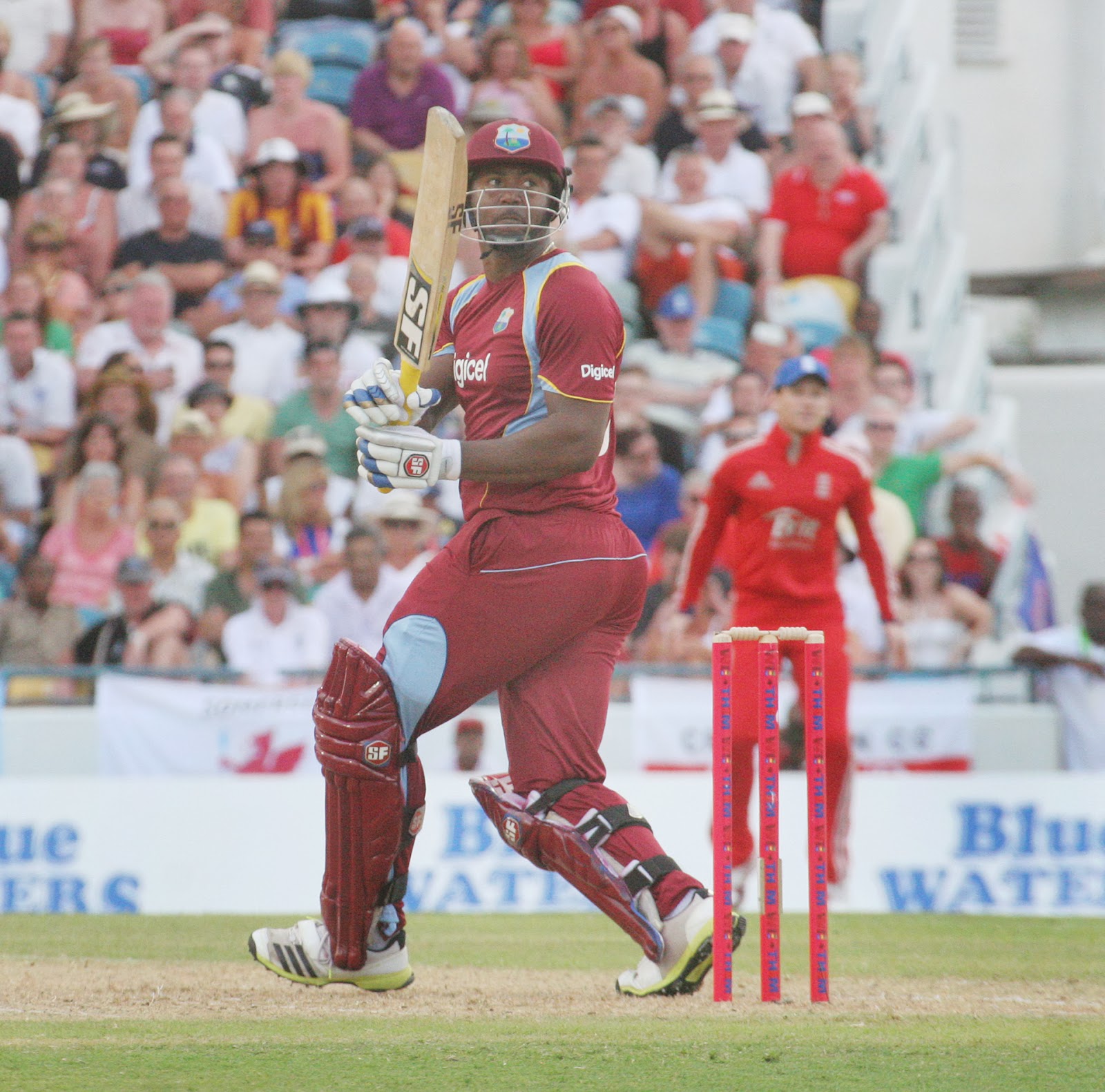 |
| West Indies Dwayne Smith got his team off to a flying start in the power play. |
Smith was the more aggressive of the two batsmen in the opening stages however he was also the first to be dismissed in the fifth over. He went for 30 runs off 16 balls which included two boundaries and three sixes.
The run rate started to decline dramatically after that and Gayle was to the next to go, chopping a ball on his stumps which was delivered by Ravi Bopara after struggling to get away James Tredwell.
But Sammy’s whirlwind innings secured the victory for the home team with 30 runs coming off just nine balls.
England got off to a horrid start and was reeling on 26/3 after Santokie took two of their top order batmen via the lbw route.
 |
| West Indies Chris Gayle chopping the ball onto his stumps. |
The recovery was done by Jos Butler and Alex Hales as they put on a 76 run partnership before Hales was out for 40 off 36 balls. However this partnership was aided by a number of dropped catches before one was finally hauled in.
Santokie returned for his final over to take two wickets, which included the dangerous Butler for 67 off 43 balls. Butler’s innings included five boundaries and three sixes.
The final ball of the innings also yielded a wicket as Bravo had Bresnan caught behind the wicket by wicketkeeper Dinesh Ramdin.
West Indies headed into the final game yesterday assured of the series victory and with the leverage of trying different combinations as they prepare to defend their World Cup title.
SCOREBOARD
England innings
M. Lumb lbw K. Santokie 04
A. Hales c Simmons b D Bravo 40
M. Ali lbw K. Santokie 05
E. Morgan c L Simmons b S. Badree 03
J. Butler c D Sammy b K. Santokie 67
R. Boparao c D Bravo b K. Santokie 14
L Wright not out 07
T.Bresnan c w/kpr D Ramdin b D Bravo 07
Extras (b1, lb 3, w 1) 05
TOTAL 152/7 off 20 overs
Fall of wickets: 13, 21, 26, 102, 137, 143, 152
Bowling: S. Badree 4-0-16-1, K. Santokie 4-0-21-4, M. Samuel 2-0-17-0, R. Rampaul 3-0-30-0, D. Sammy 1-0-17-0, D. Bravo 4-0-34-2, A. Russell 2-0-13-0.
West Indies innings
D. Smith c T. Bresnan b J Dernbach 30
C. Gayle b Bopara 36
M. Samuels c Hales b T Bresnan 28
L. Simmons c w/kpr J. Butler b Wright 19
A. Russell c Hales b T Bresnan 02
D. Sammy not out 30
D. Bravo not out 8
Extras: (w 2) 02
TOTAL 157/5 off 20 overs
Fall of wickets: 48, 75, 111, 116, 116
Bowling: T. Bresnan 3.5-0-51-2, J. Dernbach 3-0-30-1, J. Tredwell 4-0-27-0, R. Bopara 4-0-10-1, S. Parry 2-0-17-0, L Wright 2-0-20-1.
Subscribe to:
Posts (Atom)